While it seems highly possible to go on for tomes in the service of expositing upon the subject of love-- indeed if we think correctly about it, the entirety of all that is written on the Christian God and the world from the perspective of belief in that God is about love-- the object of this essay won't be so much the delving into every aspect of love, but a particular facet: the love that exists between a free man and a free woman.
First, freedom.
Who can truly give their mind, soul, and body when pressured or forced? A gift of the self must be one that is freely and selflessly given. It cannot be coerced or manipulated, strangled or cajoled. The heart and body of a person given are gifted in ecstasy, not in sorrow or pain. (Granted, however, that love in it's life between two people undergoes its share of pain and turmoil.) Freedom is essential to the fullness of a gift of self, it is what makes the gift truly a gift. What we find then within the giving of one person to another in freedom is love.
Now, we can certainly begin to talk about persons who are "free" yet under the constraints of psychological or physical oppressions-- like drug, sex, or alcohol addictions-- which are in themselves constraints to a complete self giving. However, these are not barring in the way that being under the marriage bond already or in priestly orders are. The sense of freedom that enables one to give one's self completely must be present in order for love itself to be there. God accepts our service and faith most ardently when they are freely given, for then they are given by the whole person.
Since there first needs to be freedom, it means that love is then an act of the will: informing our choices and moving us constantly in the direction of the object desired, the beloved. When I make a cognisant act of the will and choose to love someone, I choose out of my freedom-- to love therefore must be not only something willed, it must be constantly chosen, constantly fought for, constantly born.
Now is when I run the risk of turning this essay into a dramatically poetic excursion, but I'll keep that for the letters that I write to my future bride.
There is a point, however, when turning to the experience of love, coming to grips with what must be sacrificed and offered, and acknowledging how love ought to grow in its proper way, is the primary starting point in understanding it. The life of romantic love is such a multi-faceted experience and act that it requires so much in order to come to terms with it and to live it out fully as it should be.
Perhaps a clarification is necessary when I say "romantic love". Romantic love is a law, a gift, and a right that can only fully exist between one man and one woman. The complementarity of man to woman is the crux here, as each was made in God's image to reflect an aspect of being that aims toward substantial unity both one in the other and in the God who created them for one another. The late Pontiff John Paul II did much to aid the Church's people in understanding the nature of this complementarity, but that is not the point here. Romantic love, being that act and experience that exists between a man and a woman lives and breathes completely and fully in marriage-- as the fulfillment of a vow of exclusivity, fidelity, and fruitfulness.
Romance is more than flowers and delicate champagne, it's the expression of total self-giving in every way: physically, intellectually, and emotionally at every moment. It is ever striving to put the other first for their own sake, with no expectation of return, though met with exuberant bliss and gratefulness at its occurrence. Romance in my mind exists as a way for me to give myself unceasingly to her whom God has given to me. It's obvious that this notion of gift is spread deeply in the perception of love played out here... and rightly so. Not only did Pope John Paul II express love as a gift of self, but in my own experience it remains ever clear that the only way to make love grow is to put the other first. Her wants and her needs must be those ever present on my mind-- if they aren't then I must find a way to put her first. She comes to me from God as not only a goddess and an angel, but as God's presence in my life: a theophany if you will. Our love is then an encounter with God, and how can such an encounter be sullied by my selfishness? She, as God, must come first in my life. It is the essential gift of self that makes it possible for romance to grow and become the full love that is expressed in body and soul.
The picture at the beginning of this essay is a depiction of the wedding night of Tobias and Sarah. I offer it as a window into how love ought to be in the life of married people who are deeply in love. In the account from the book of Tobit, Tobias sets out to find his future wife, Sarah. Sarah, however, has been married seven times before. Each time, the husband was found the morning after the wedding, dead. They had married Sarah out of lust, and so God allowed them to be taken by a demon before they could taint the body and soul of Sarah with their selfish passions. Tobias, upon meeting Sarah and proposing marriage to her father, did not seek the marriage for the sake of his passions, but rather out of goodness and love. As such, he made the first three nights of marriage ones dedicated to prayer in order to sanctify their love and wedding bed. The morning after the wedding, all were surprised and shocked to see Tobias come out of the wedding chamber alive... God had kept him alive for his love for Sarah was pure and selfless. It put Sarah and a love for her first.
In the painting above, by Dutch Golden Age painter Jan Steen, Tobias and Sarah pray at the foot of their wedding bed, but off to the right, the Archangel Raphael slays a dragon. The dragon can either represent the demon Asmodeus who had killed Sarah's other husbands, but I think rather that it is the representation of lust. St. Raphael conquers lust, preventing it from perverting the love that dwells between Tobias and Sarah, keeping it pure and selfless. (On a side note... purity is not to be confused with prudery. The two are actually opposites. Purity rather, is selflessness and an understanding of the dignity of the human person.)
The painting helps us to visualize what ought to be the norm for love between man and wife... that it is constant giving of one to the other. The gift of one's self is something that is for all eternity; it is exclusive, never to be given to another; it is fruitful-- it is as love itself is: diffusive and without selfishness.
As we pass out of the week that is marked by the secular world's celebration of Valentine's Day, let us remember that it is actually St. Valentine's Day. It should be an occasion for us to remember the depth of selflessness that is required to completely love someone. I will, for my part, make it a time to not only send some chocolates and beautiful flowers, but also move to more truly love the one who is God's presence in my life. It will also be the chance to be a better man for her who was given to me, that I might more perfectly give myself to her.
Thursday, February 17, 2011
Wednesday, February 2, 2011
Taking the Time
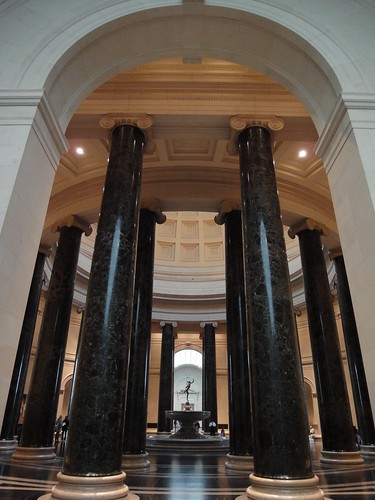
This past weekend I found myself wandering the halls of a much beloved home: The National Gallery of Art in Washington, DC. (Now, I should note that while I am glad there are such wide varieties of artistic style as post modernism and abstract expressionism I do not regard myself as a connoisseur of the same for various cultural theory reasons that will come out as the life of this forum grows and evolves.)
I went to the West Gallery of Art-- the more classically built and oriented of the two gallery buildings. It was the closing day of a special exhibit focusing on pre-Raphaelite photography and painting. It was fascinating to see-- sometimes side by side-- the old black and white photograph that inspired the marvelously colourful and emotive painting. It was typical of the pre-Raphaelites to focus on mediaeval and other historical topics; sometimes featuring characters from literature such as Ophelia, the Lady of Shallot, or Proserpine. The overarching theme, seems to me, to be the sort of idealised beauty and emotion of particular moments. There is no pointing to a cold form as in the pre-Renaissance masters or Neo-Platonic Christian icons. Rather, there is a warmth that emanates from an individual person's beauty, the colours are inviting: deep, rich, and vibrant-- not cool and pale or faded. The features of the face are important as well, conveying the feelings and moods of the subject with an astuteness that wasn't the point for the pre-Renaissance artists.
Painters such as Millais, Hunt, and Rossetti typify the period-- especially given that there was ample amount of collaboration between them-- with the depth of adoration to psychical experiences in the person and moreover the near deistic devotion to nature. There are undoubtedly others who can evaluate the technicalities of this particular artistic movement with greater adeptness than I can, yet while I took away much from gazing on the sublime renderings of ideas and loves on canvas (and other materials as well), what I really appreciated was the sense of time. That is to say, time taken to be.
Our lives are often absorbed by the chores and tasks of everyday life: commuting, buying groceries, cleaning the kitchen, writing emails, etc. But Josef Pieper, a German philosopher of the 20th century, did wonders to expose us to the necessity of taking time outside of merely work and recreation.
The true intellectual life requires us to not be mired continually in the "work-a-day" world as Pieper called it. The life of the mind requires us to step out of that routine-- aptly enough, to take time away from it. The term that Pieper uses to describe this time separate from work and recreation is leisure. Leisure is a term that Pieper derives from Aristotle who in this way was the originator of Pieper's theory on leisure as expounded upon in Leisure: The Basis of Culture. (Aristotle's notable treatment on leisure is to be found in the first book of his Metaphysics.) Leisure in this sense is not at all the idea contemporary culture has. To our contemporaries, we are at leisure when we "lazy about" watching television, munching on Sun Chips. Yet, the word leisure in itself comes originally from the Latin word schola (school), which itself relates back to the Greek word schole (σχολείο). Both words refer in some sense to the modern idea of school... and ultimately to education.
Leisure, therefore, if we are to take it seriously-- at least from its ancient roots-- is to be a time of study, education, and contemplation. Rather than viewing our week as a mere process of work and rest (the work-a-day world) it should be impacted by time taken to educate: to converse deeply, contemplate a painting by simply being in its presence, or read something perhaps normally beyond our academic purview. Leisure should be an occasion for the mind to exercise; not solely as an effort to learn, but as an expression of freedom (but this is a political point, and not something entirely suited to the nature of this essay.)
If we take leisure in this way, we will open ourselves to a world of opportunity: a walk in the forest becomes an outing that absorbs the beauty of the cosmos and man's place within it. A conversation with a friend need not abide to the confines of banal talk about the weather, but it can drift to the heights of debating the essence of virtue or the meaning of a turn of phrase in G.K. Chesterton's Everlasting Man. Likewise, a trip to the art museum for the sake of one's romantic interest can fall into the pool of colour and transport us to an understanding of the notions and philosophies of the past-- in this way teaching us how to understand the past and engage with it, not merely on the pages of a written history but also on the living pages of our family and country.
Our leisure time is something precious that we must guard with fidelity and prudence. It should be a time not only for relaxation, but moreover for educating and nurturing our minds in a love of knowledge and an appreciation of the beauty and goodness of the world.
I went to the West Gallery of Art-- the more classically built and oriented of the two gallery buildings. It was the closing day of a special exhibit focusing on pre-Raphaelite photography and painting. It was fascinating to see-- sometimes side by side-- the old black and white photograph that inspired the marvelously colourful and emotive painting. It was typical of the pre-Raphaelites to focus on mediaeval and other historical topics; sometimes featuring characters from literature such as Ophelia, the Lady of Shallot, or Proserpine. The overarching theme, seems to me, to be the sort of idealised beauty and emotion of particular moments. There is no pointing to a cold form as in the pre-Renaissance masters or Neo-Platonic Christian icons. Rather, there is a warmth that emanates from an individual person's beauty, the colours are inviting: deep, rich, and vibrant-- not cool and pale or faded. The features of the face are important as well, conveying the feelings and moods of the subject with an astuteness that wasn't the point for the pre-Renaissance artists.
Painters such as Millais, Hunt, and Rossetti typify the period-- especially given that there was ample amount of collaboration between them-- with the depth of adoration to psychical experiences in the person and moreover the near deistic devotion to nature. There are undoubtedly others who can evaluate the technicalities of this particular artistic movement with greater adeptness than I can, yet while I took away much from gazing on the sublime renderings of ideas and loves on canvas (and other materials as well), what I really appreciated was the sense of time. That is to say, time taken to be.
Our lives are often absorbed by the chores and tasks of everyday life: commuting, buying groceries, cleaning the kitchen, writing emails, etc. But Josef Pieper, a German philosopher of the 20th century, did wonders to expose us to the necessity of taking time outside of merely work and recreation.
The true intellectual life requires us to not be mired continually in the "work-a-day" world as Pieper called it. The life of the mind requires us to step out of that routine-- aptly enough, to take time away from it. The term that Pieper uses to describe this time separate from work and recreation is leisure. Leisure is a term that Pieper derives from Aristotle who in this way was the originator of Pieper's theory on leisure as expounded upon in Leisure: The Basis of Culture. (Aristotle's notable treatment on leisure is to be found in the first book of his Metaphysics.) Leisure in this sense is not at all the idea contemporary culture has. To our contemporaries, we are at leisure when we "lazy about" watching television, munching on Sun Chips. Yet, the word leisure in itself comes originally from the Latin word schola (school), which itself relates back to the Greek word schole (σχολείο). Both words refer in some sense to the modern idea of school... and ultimately to education.
Leisure, therefore, if we are to take it seriously-- at least from its ancient roots-- is to be a time of study, education, and contemplation. Rather than viewing our week as a mere process of work and rest (the work-a-day world) it should be impacted by time taken to educate: to converse deeply, contemplate a painting by simply being in its presence, or read something perhaps normally beyond our academic purview. Leisure should be an occasion for the mind to exercise; not solely as an effort to learn, but as an expression of freedom (but this is a political point, and not something entirely suited to the nature of this essay.)
If we take leisure in this way, we will open ourselves to a world of opportunity: a walk in the forest becomes an outing that absorbs the beauty of the cosmos and man's place within it. A conversation with a friend need not abide to the confines of banal talk about the weather, but it can drift to the heights of debating the essence of virtue or the meaning of a turn of phrase in G.K. Chesterton's Everlasting Man. Likewise, a trip to the art museum for the sake of one's romantic interest can fall into the pool of colour and transport us to an understanding of the notions and philosophies of the past-- in this way teaching us how to understand the past and engage with it, not merely on the pages of a written history but also on the living pages of our family and country.
Our leisure time is something precious that we must guard with fidelity and prudence. It should be a time not only for relaxation, but moreover for educating and nurturing our minds in a love of knowledge and an appreciation of the beauty and goodness of the world.
Friday, January 28, 2011
Festa Dies, Doctor Angelicus
Today, January 28th is the feast of St. Thomas Aquinas. For those of us who have had philosophy as not merely a course of study, but also as a love-- for indeed philosophy literally means a love of wisdom-- today has special meaning as an occasion to celebrate with our bodies and minds one of the most important thinkers not only of mediaeval times, but of all history.
The Dominican friar from Italy was born in 1225 at his family's castle near Aquino. His life-- spent in service to God through his study of sacred and natural truths-- came to an abrupt end in 1274 when he was en route to the Second Council of Lyon. Most who would even dare to read the literary and cultural forays on this site no doubt are familiar with the life and virtues of St. Thomas, as such, it seems rather trite for me to go about offering a biography when Jean-Pierre Torrell, O.P. has done a finer job than I could ever do.
I suppose then that my task here is to take the great legacy of the Doctor Communis and move forward with it--both in terms of progressing individually in intellect and virtue, and in advancing the greater common good through knowledge of the truth. Culturally speaking, St. Thomas's philosophy is more than a mere source for metaphysical discussions that have no apparent practical import; rather, his thought is a source of metaphysical principles that help to order the mind and society. The axiom "good theory begets good practise" comes to mind here. Though we shouldn't be quick to judge any particular set of principles solely on the practical import it has. For example, it would be quite incorrect (and hasty) to assert that because person x is a murderer, and person x studied scholastic philosophy that scholastic philosophy leads to the generation of murderers. There are undoubtedly many facets involved in the generation of a murderer, but we would be false in thinking that scholastic philosophy is necessarily the tipping point.
Good theory is in itself good-- and should be valued precisely because of its goodness. A holy monk or nun who does God's work by contemplation and prayer with each passing day and night does just as much good work as someone assisting the poor by acts of corporeal service. Both are different, yet both are good in themselves. St. Thomas, while known for his practical philosophy (ius naturale, amongst others), is highly regarded for his metaphysical philosophy, which was perhaps largely the result of reconciling St. Augustine's theological system with Aristotle's system of natural philosophy.
Like I said, many reasons to celebrate today.
From a more practical side, however, St. Thomas offers some of the most inspiring thought on the virtues-- in essence his psychological treatises-- which never cease to occupy much of my thought, especially when I consider how I acted in any given moment and how I need to change or do better. Virtues, as Aristotle said, are habits. Indeed, when we look at how we act, we can not but help noticing that the good people in our lives are those who often times make it seem easy to be good. When you think of that Uncle or Grandmother who always seems to be above everything, and always charitable and hopeful, it seems like being good is as easy as simply willing it. To some extent it is that easy, but we know after reading the Nicomachean Ethics that being good-- or having an excellence about us-- is the repetition of a particular action in tandem with seeing others do the same. Goodness and virtue can be in born, but for most of us they are the products of hard work, careful introspection...and much criticism.
For the import of culture-- one of the essential matrices-- St. Thomas acts as an underpinning to the co-existence and complementarity between faith and reason. St. Thomas finds the healthy agreement that exists between a reasonable faith and a believing reason. Étienne Gilson discussed this fitting together of two supposedly improbable puzzle pieces in his Reason and Revelation in the Middle Ages. While Gilson poses the wide variety of responses to the question of how reason and revelation work together, from Tertullian to St. Bonaventure and Averroes, we are presented ultimately with the figure of St. Thomas who acts as the foundation to a proper understanding of the interrelation between faith and reason.
Given our contemporaries' fixation on the animosity between the two, St. Thomas is a wonderful source for guidance on the purely Catholic view that reason without faith is hopeless, and faith without reason is dead. When we abstract faith and act as though reason is an enemy, we are taking away from ourselves an angle and a lens through which we can more clearly see our religion and experience the God Who from the beginning endowed us with the precious ability to think and abstract-- to ponder, wonder, feel, express, and ultimately love.
St. Thomas should be a paragon for our vision of the world: as a place full of wonder and mystery; as an unfolding before our eyes of the Love of God Who not only gave His only Son for our redemption, but the beauty of the cosmos for our enjoyment, for our virtue-- one another for manifestations of His Love-- and all that is for the exhilaration of simple joy that comes from knowing the truth of things.
The Dominican friar from Italy was born in 1225 at his family's castle near Aquino. His life-- spent in service to God through his study of sacred and natural truths-- came to an abrupt end in 1274 when he was en route to the Second Council of Lyon. Most who would even dare to read the literary and cultural forays on this site no doubt are familiar with the life and virtues of St. Thomas, as such, it seems rather trite for me to go about offering a biography when Jean-Pierre Torrell, O.P. has done a finer job than I could ever do.
I suppose then that my task here is to take the great legacy of the Doctor Communis and move forward with it--both in terms of progressing individually in intellect and virtue, and in advancing the greater common good through knowledge of the truth. Culturally speaking, St. Thomas's philosophy is more than a mere source for metaphysical discussions that have no apparent practical import; rather, his thought is a source of metaphysical principles that help to order the mind and society. The axiom "good theory begets good practise" comes to mind here. Though we shouldn't be quick to judge any particular set of principles solely on the practical import it has. For example, it would be quite incorrect (and hasty) to assert that because person x is a murderer, and person x studied scholastic philosophy that scholastic philosophy leads to the generation of murderers. There are undoubtedly many facets involved in the generation of a murderer, but we would be false in thinking that scholastic philosophy is necessarily the tipping point.
Good theory is in itself good-- and should be valued precisely because of its goodness. A holy monk or nun who does God's work by contemplation and prayer with each passing day and night does just as much good work as someone assisting the poor by acts of corporeal service. Both are different, yet both are good in themselves. St. Thomas, while known for his practical philosophy (ius naturale, amongst others), is highly regarded for his metaphysical philosophy, which was perhaps largely the result of reconciling St. Augustine's theological system with Aristotle's system of natural philosophy.
Like I said, many reasons to celebrate today.
From a more practical side, however, St. Thomas offers some of the most inspiring thought on the virtues-- in essence his psychological treatises-- which never cease to occupy much of my thought, especially when I consider how I acted in any given moment and how I need to change or do better. Virtues, as Aristotle said, are habits. Indeed, when we look at how we act, we can not but help noticing that the good people in our lives are those who often times make it seem easy to be good. When you think of that Uncle or Grandmother who always seems to be above everything, and always charitable and hopeful, it seems like being good is as easy as simply willing it. To some extent it is that easy, but we know after reading the Nicomachean Ethics that being good-- or having an excellence about us-- is the repetition of a particular action in tandem with seeing others do the same. Goodness and virtue can be in born, but for most of us they are the products of hard work, careful introspection...and much criticism.
For the import of culture-- one of the essential matrices-- St. Thomas acts as an underpinning to the co-existence and complementarity between faith and reason. St. Thomas finds the healthy agreement that exists between a reasonable faith and a believing reason. Étienne Gilson discussed this fitting together of two supposedly improbable puzzle pieces in his Reason and Revelation in the Middle Ages. While Gilson poses the wide variety of responses to the question of how reason and revelation work together, from Tertullian to St. Bonaventure and Averroes, we are presented ultimately with the figure of St. Thomas who acts as the foundation to a proper understanding of the interrelation between faith and reason.
Given our contemporaries' fixation on the animosity between the two, St. Thomas is a wonderful source for guidance on the purely Catholic view that reason without faith is hopeless, and faith without reason is dead. When we abstract faith and act as though reason is an enemy, we are taking away from ourselves an angle and a lens through which we can more clearly see our religion and experience the God Who from the beginning endowed us with the precious ability to think and abstract-- to ponder, wonder, feel, express, and ultimately love.
St. Thomas should be a paragon for our vision of the world: as a place full of wonder and mystery; as an unfolding before our eyes of the Love of God Who not only gave His only Son for our redemption, but the beauty of the cosmos for our enjoyment, for our virtue-- one another for manifestations of His Love-- and all that is for the exhilaration of simple joy that comes from knowing the truth of things.
Thursday, January 27, 2011
Can you imagine...
Life without Mozart?...Wolfgang Amadeus Mozart that is. His father's music was fantastic too-- his Sinfonia di Caccia is a personal favourite. Yet, his son's compositions shine like a beacon within the history of Western music.
But... to return to my original question: Can you imagine life without Mozart? To some, the question might be a non sequitur because it's obvious that we can "live" without the Austrian's music. However, can we truly Live? There are two senses of which we can speak of when we say "live". The first can be taken as living in a merely biological or instinctual way: by eating and sleeping and fulfilling the other functions that we as rational animals (to quote Aristotle) share with the lower animals. Conversely, the second sense of living means an experience and an abstraction apart from the basic necessities of life... it means to think and contemplate: to express the "divine spark" inherent within us. When we think and contemplate, we live in a way that fulfills our rational nature and as the ancients said, ignites the God within us.
All of this is to say (or rather ask): Can we live a full and rational life without Mozart?
Plainly and simply, my answer is no.
The richness of Wolfgang's music has left the world a better place-- despite this cliché it remains a verity. So many people recognize the beauty that emanates from Mozart's compositions, from his sonatas, Masses, operas (who can forget the arias of Le Nozze di Figaro and Die Zauberflöte?), to magnificent symphonies and concertos. Recently, my fiancée and I attended a concert at which there was a performance of Mozart's symphony No. 23, followed by a Dvořák concerto. After the orchestra finished playing Mozart's symphony, the audience gave a rousing standing ovation, which was quite loud and powerful. Following the bravos and cheers, nearly half of those in attendance got up and left.
It was simply astounding to see how people would disregard another magnificent artist-- for Dvořák's music is indeed beautiful and moving-- just to listen to a sublime performance of a Mozart symphony. It proved to me right then and there that Mozart's music has something more in it, something more than simply entertainment value, but an expression of pure divine beauty. The melodies and themes, the allegros and the largos... everything about Mozart's music that makes it Mozart's is what sets him apart not merely in our hearing, but in our feeling... in our very souls.
Whether melancholic like the clarinet concerto, moving and giddy like Le Nozze di Figaro, solemn like the Jupiter symphony, reverent and glorious like the Exultate Jubilate, tragically joyful like the Requiem Mass, or chipper and singing like the piano concerto No. 22... nothing seems to touch the heart and mind like Mozart's music. Ever since youth, it left an indelible mark on my intellectual life as a source of solace and beauty-- it has in many ways been an impetus to the wonderful friendships I have (and of course it helped me to fall more deeply in love with my musical fiancée.) Music like his inspires and influences thinking. His dramatic musical poetry flows with a graced liquidity that the spirit drinks up with such fervor that often times there seems to be a slippage from reality. A type of immersion in the world of Mozart's music that both elevates yet enables us to be more aware of the beauty in every aspect of the world around us.
His music is like wine, poured out into the spirit that inebriates us with a sweetness that surpasses all years and tastes. The melodies of his work remain enchanting and mysterious for their ability to set us on fire.
Perhaps it's fitting then that I write such praise, for today is Mozart's birthday. On this day, January 27th, Wolfgang Amadeus Mozart was born in the Archbishopric of Salzburg in the year 1756.
So... have a glass of wine, or scotch, put on some Mozart and relish in the music and the man that "gave us God's eternal laughter."
But... to return to my original question: Can you imagine life without Mozart? To some, the question might be a non sequitur because it's obvious that we can "live" without the Austrian's music. However, can we truly Live? There are two senses of which we can speak of when we say "live". The first can be taken as living in a merely biological or instinctual way: by eating and sleeping and fulfilling the other functions that we as rational animals (to quote Aristotle) share with the lower animals. Conversely, the second sense of living means an experience and an abstraction apart from the basic necessities of life... it means to think and contemplate: to express the "divine spark" inherent within us. When we think and contemplate, we live in a way that fulfills our rational nature and as the ancients said, ignites the God within us.
All of this is to say (or rather ask): Can we live a full and rational life without Mozart?
Plainly and simply, my answer is no.
The richness of Wolfgang's music has left the world a better place-- despite this cliché it remains a verity. So many people recognize the beauty that emanates from Mozart's compositions, from his sonatas, Masses, operas (who can forget the arias of Le Nozze di Figaro and Die Zauberflöte?), to magnificent symphonies and concertos. Recently, my fiancée and I attended a concert at which there was a performance of Mozart's symphony No. 23, followed by a Dvořák concerto. After the orchestra finished playing Mozart's symphony, the audience gave a rousing standing ovation, which was quite loud and powerful. Following the bravos and cheers, nearly half of those in attendance got up and left.
It was simply astounding to see how people would disregard another magnificent artist-- for Dvořák's music is indeed beautiful and moving-- just to listen to a sublime performance of a Mozart symphony. It proved to me right then and there that Mozart's music has something more in it, something more than simply entertainment value, but an expression of pure divine beauty. The melodies and themes, the allegros and the largos... everything about Mozart's music that makes it Mozart's is what sets him apart not merely in our hearing, but in our feeling... in our very souls.
Whether melancholic like the clarinet concerto, moving and giddy like Le Nozze di Figaro, solemn like the Jupiter symphony, reverent and glorious like the Exultate Jubilate, tragically joyful like the Requiem Mass, or chipper and singing like the piano concerto No. 22... nothing seems to touch the heart and mind like Mozart's music. Ever since youth, it left an indelible mark on my intellectual life as a source of solace and beauty-- it has in many ways been an impetus to the wonderful friendships I have (and of course it helped me to fall more deeply in love with my musical fiancée.) Music like his inspires and influences thinking. His dramatic musical poetry flows with a graced liquidity that the spirit drinks up with such fervor that often times there seems to be a slippage from reality. A type of immersion in the world of Mozart's music that both elevates yet enables us to be more aware of the beauty in every aspect of the world around us.
His music is like wine, poured out into the spirit that inebriates us with a sweetness that surpasses all years and tastes. The melodies of his work remain enchanting and mysterious for their ability to set us on fire.
Perhaps it's fitting then that I write such praise, for today is Mozart's birthday. On this day, January 27th, Wolfgang Amadeus Mozart was born in the Archbishopric of Salzburg in the year 1756.
So... have a glass of wine, or scotch, put on some Mozart and relish in the music and the man that "gave us God's eternal laughter."
Beginnings...
Like Evelyn Waugh, using Et in Arcadia Ego as a starting point is more than tempting-- considering our common (and antiquated) methods for belief and philosophy. This should first of all tell you something important about this "blog." It will hardly be a blog in the ordinary sense... yes there will be convenient amounts of bloviation, though hopefully more substantial. Yet, the overarching theme of this site will be one focused on the culture; from its many perspectives. Art, literature, music, conversation, family, government and politics-- it will all be the object of thought and contemplation in a manner that essentially breathes the free Catholic air.
Catholicism in this vein, therefore, is more than just an assumption of certain dogmas. No, rather it is an understanding and a context. It is the fundamental placing of a person and his ideas within the world he occupies, and the world he has come from. Someone once said that to be Catholic meant that one had to have an understanding of history. Well, here, that same will apply. But, it will also mean that history is not simply dates and figures, but ideas-- their impact-- and the plight of beauty, truth, and goodness, in a world that sometimes looses sight of them.
I will come to this table offering the insights of someone who has grown-up Catholic and likes to think that he sees the world through such clear eyes. The world of culture is an ever changing thing, and indeed it is something that permeates (for it ought to) ever segment and moment of our lives... this is object of our forum here.
Finally, we should always be mindful of the fact that while we use culture and its products for various means-- such as getting an A on that Baroque Art exam, or impressing a beautiful girl with our knowledge of Rosetti's poetry-- it is, and must be approached as, something worthwhile in itself... something good for its own sake.
Welcome to Culture and Catholicism!
Catholicism in this vein, therefore, is more than just an assumption of certain dogmas. No, rather it is an understanding and a context. It is the fundamental placing of a person and his ideas within the world he occupies, and the world he has come from. Someone once said that to be Catholic meant that one had to have an understanding of history. Well, here, that same will apply. But, it will also mean that history is not simply dates and figures, but ideas-- their impact-- and the plight of beauty, truth, and goodness, in a world that sometimes looses sight of them.
I will come to this table offering the insights of someone who has grown-up Catholic and likes to think that he sees the world through such clear eyes. The world of culture is an ever changing thing, and indeed it is something that permeates (for it ought to) ever segment and moment of our lives... this is object of our forum here.
Finally, we should always be mindful of the fact that while we use culture and its products for various means-- such as getting an A on that Baroque Art exam, or impressing a beautiful girl with our knowledge of Rosetti's poetry-- it is, and must be approached as, something worthwhile in itself... something good for its own sake.
Welcome to Culture and Catholicism!
Subscribe to:
Posts (Atom)